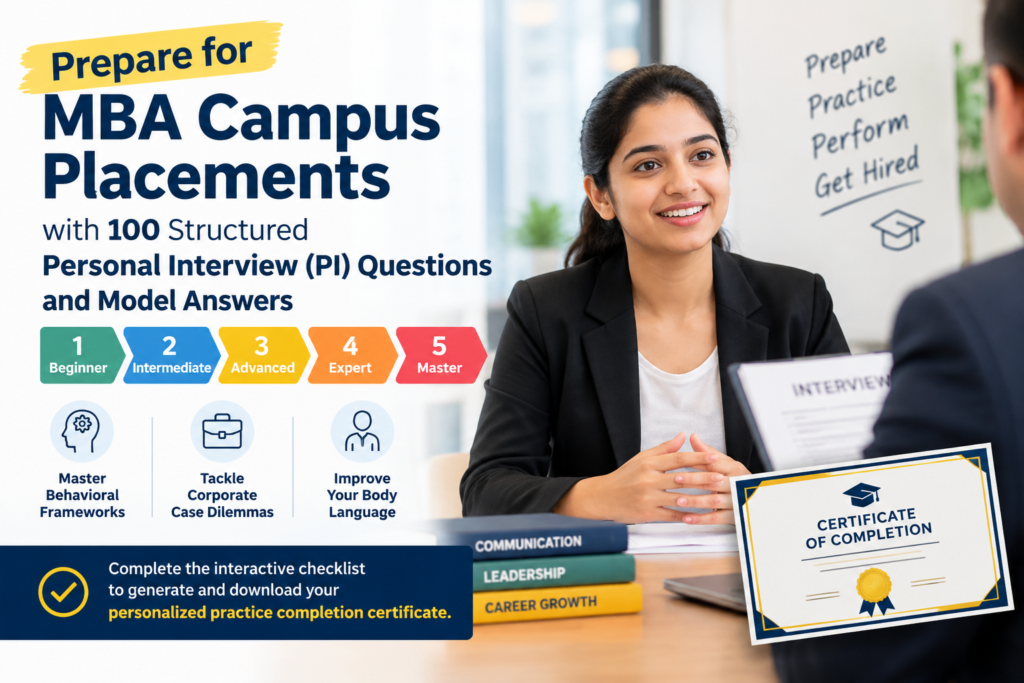
MBA campus placement interview preparation with 100 PI questions

MBA PI Masterclass: 100 Interview Questions, Frameworks & Free Completion Certificate

MBA PI Interview Master Practice Handbook

100 Comprehensive Questions & Answers Arranged Across 5 Progressive Levels with Step-by-Step Tabbed Navigation

Important Instruction for Students: Don't memorize the sample answers word-for-word. Use the structure and logic, but replace the examples with your own academic, internship, project, family-business, extracurricular or work experience.
Interview Complexity Progression Graph
Visualizing candidate evaluation depth across the 5 practice tiers. Click any step bar to jump directly into that level's questions.
Tier 1 Profile & Basics
L1 (Easy)
Tier 2 Corp Awareness
L2 (Moderate)
Tier 3 Cases & Ops
L3 (Challenging)
Tier 4 Cross-Func & Ethics
L4 (Difficult)
Tier 5 C-Suite Strategy
L5 (Executive)
Overall Progress: 0 / 100 Questions Completed 0%
Tick the checkbox after reviewing each question. Complete all 100 to enable your certificate.

Level 1: Basic PI & Academic/Career Choice (Questions 1–20)

Focuses on personal background, self-awareness, career motivation, and academic specialization alignment.

1. Tell me about yourself.
Sample Answer: “Good morning, sir/ma'am. I am Rahul Sharma, currently pursuing my MBA in Marketing. I completed my graduation in B.Com, where I developed an interest in consumer behaviour and business strategy. During my graduation, I participated in college presentations and a marketing project, which helped me improve my communication and analytical skills. I chose an MBA because I want to understand business from a broader managerial perspective and eventually build my career in marketing and sales.”
Body Language: Sit upright, smile naturally, maintain comfortable eye contact. Avoid rushing through your introduction.
2. Why did you choose MBA?
Sample Answer: “I chose an MBA because I wanted to move beyond theoretical knowledge and understand how different business functions work together. During graduation, I became interested in marketing, but I realized that a good manager also needs knowledge of finance, operations, HR and strategy. MBA gives me that broader business perspective.”
Body Language: Slight forward lean when explaining your motivation. Keep your hands relaxed.
3. Why should we hire you?
Sample Answer: “I believe I can contribute through my willingness to learn, communication skills and ability to work with people. I may be at the beginning of my corporate career, but I am comfortable taking responsibility, receiving feedback and learning quickly. I would bring a disciplined and learning-oriented approach to the role.”
Body Language: Confident eye contact. Don't point toward yourself repeatedly.
4. What are your strengths?
Sample Answer: “One of my strengths is that I remain organized when I have multiple responsibilities. I also communicate comfortably with people and try to understand different viewpoints before responding. I am currently working on converting these strengths into stronger managerial capabilities.”
Body Language: Use one or two natural hand gestures. Don't list five or six strengths.
5. What is one weakness you are working on?
Sample Answer: “Earlier, I sometimes spent too much time making a task perfect before submitting it. I have been working on balancing quality with deadlines by prioritizing what is important and setting time limits for each task.”
Body Language: Be calm. Don't look down when discussing weakness.
6. Where do you see yourself in five years?
Sample Answer: “In five years, I would like to be a dependable professional with strong functional expertise and some experience in handling responsibilities independently. I would also like to develop leadership capabilities so that I can contribute not only individually but also as part of a team.”
Body Language: Maintain steady eye contact; avoid looking upward as though searching for a memorized answer.
7. Why should we select you over another candidate?
Sample Answer: “I would not compare myself directly with another candidate because I don't know their strengths. What I can say is that I bring curiosity, adaptability and a willingness to take feedback. If selected, I would focus on demonstrating those qualities through my work rather than simply claiming them.”
Body Language: This is a maturity test. Remain composed and avoid an aggressive tone.
8. What motivates you?
Sample Answer: “I am motivated by learning and visible improvement. When I learn something new and can apply it to solve a problem or improve a result, I find that very motivating.”
Body Language: A slight smile helps. Speak with genuine energy.
9. Are you a team player?
Sample Answer: “Yes. During group projects, I have learned that being a team player does not mean agreeing with everyone. It means communicating your viewpoint respectfully, listening to others and working toward the common objective.”
Body Language: Open palms and relaxed shoulders.
10. Do you have any questions for us?
Sample Answer: “Yes, sir/ma'am. I would like to understand what capabilities you would expect an MBA fresher to develop during the first six months in this role.”
Body Language: Ask with genuine curiosity. Don't immediately ask about salary or leave.
11. Why did you choose your MBA specialization?
Sample Answer: “I chose Finance because I enjoy working with numbers and understanding how financial decisions influence business performance. During my graduation, subjects such as financial management and accounting increased my interest in the area.”
Body Language: Nod slightly when explaining your interest.
12. What is the difference between a manager and a leader?
Sample Answer: “A manager is generally responsible for planning, organizing and controlling resources to achieve objectives. Leadership is more about influencing and motivating people toward a shared goal. In practice, an effective manager often needs leadership skills as well.”
Body Language: Use your fingers subtly to distinguish the two concepts.
13. Which MBA subject do you like most?
Sample Answer: “Marketing interests me the most because it combines analytical thinking with understanding consumer behaviour. I particularly enjoy studying how companies use positioning, pricing and communication to create customer value.”
Body Language: Show enthusiasm but remain professional.
14. Explain your favourite subject as if I know nothing about it.
Sample Answer: “Marketing, in simple terms, is understanding what customers need and creating and communicating an offering that provides value to them. It is much broader than advertising because it also involves product, price, distribution and customer relationships.”
Body Language: Use simple hand movements to explain the four elements.
15. Tell me about your MBA project.
Sample Answer: “My project focused on customer satisfaction in digital banking. I collected primary responses, analyzed factors such as convenience, service quality and responsiveness, and then interpreted the findings. The biggest learning for me was that collecting data is only the first step; converting that data into meaningful business insights is more important.”
Body Language: Sit slightly forward. Show ownership of your project.
16. What was your biggest learning from the project?
Sample Answer: “I learned the importance of defining the research problem correctly before collecting data. If the objective is unclear, even a large amount of data may not provide useful conclusions.”
Body Language: Pause briefly before answering. This makes the answer sound thoughtful.
17. Which company do you admire and why?
Sample Answer: “I find Tata particularly interesting because of its combination of business scale and publicly stated emphasis on values such as integrity, responsibility, excellence, pioneering and unity. (Tata Group) I would like to understand how these values translate into managerial decisions at the operating level.”
Body Language: Don't sound like you are praising the company blindly. Show that you have researched it.
18. What have you learned outside the classroom?
Sample Answer: “I have learned that communication, teamwork and time management are difficult to develop only through textbooks. Presentations, group projects and extracurricular activities have helped me develop these skills.”
Body Language: Natural smile; moderate eye contact.
19. What if your specialization does not get you your first job?
Sample Answer: “I would remain flexible. My specialization gives me a foundation, but an MBA is also about developing broader business understanding. I would be willing to enter a related role where I can learn and demonstrate my capabilities.”
Body Language: Confident tone; avoid showing disappointment.
20. What is more important: marks or skills?
Sample Answer: “Both have a role, but they demonstrate different things. Marks indicate academic discipline and understanding, whereas skills show how effectively someone can apply knowledge. For a corporate role, I believe the ability to combine both is important.”
Body Language: Balanced hand gesture—avoid saying one is completely superior.

Level 2: Corporate Awareness & Team Behaviour (Questions 21–40)

Covers company research (Tata, Infosys), market positioning, peer dynamics, and receiving critical manager feedback.

21. Why do you want to join our company?
Sample Answer: “I am interested because the role matches my interest in the functional domain and the company operates at a scale where I can learn from real business challenges. I have also studied your recent business initiatives and believe the role would allow me to apply my MBA learning.”
Body Language: Eye contact. Never give a generic answer like “Your company is reputed.”
22. Why Tata?
Sample Answer: “Tata operates across multiple industries, which makes it interesting from a management-learning perspective. Its publicly stated values include integrity, responsibility, excellence, pioneering and unity. (Tata Group) I would be particularly interested in learning how those values are applied in day-to-day business decisions.”
Body Language: Maintain thoughtful posture; emphasize values aligned with operational reality.
23. Why Infosys?
Sample Answer: “Infosys interests me because of its emphasis on technology, continuous learning and professional development. Its stated values include client value, leadership by example, integrity and transparency, fairness and excellence. (Infosys) As an MBA student, I find the combination of technology and management particularly relevant.”
Body Language: Structured vocal delivery with crisp articulation.
24. What do you know about our competitors?
Sample Answer: “I would first identify the company's major competitors and then compare them on factors such as market segment, customer proposition, pricing, distribution, technology and brand positioning. I would avoid saying one company is simply 'better' because the comparison depends on the specific metric.”
Body Language: Analytical expression; don't rush.
25. If you were the marketing manager of an Indian FMCG company, how would you increase sales?
Sample Answer: “I would first identify the problem rather than immediately launching a campaign. I would examine customer segments, distribution gaps, pricing, competitor activity, product availability and repeat purchase. Then I would select the intervention based on the evidence.”
Body Language: Count the steps subtly with your fingers.
26. A Tata product is losing market share. What would you investigate first?
Sample Answer: “I would examine whether the decline is caused by changing customer preferences, competitor pricing, product quality, distribution, availability, communication or a change in the overall market. I would compare the data over time before recommending action.”
Body Language: Lean forward slightly; demonstrate problem-solving mindset.
27. How can an Indian company compete globally?
Sample Answer: “Indian companies can compete globally through quality, innovation, cost efficiency, technology, strong talent and understanding of local markets. Cost advantage alone may not be sustainable, so companies need differentiated value.”
Body Language: Firm but conversational tone.
28. What makes a brand successful?
Sample Answer: “A successful brand needs a clear value proposition, consistent customer experience, trust, relevance and the ability to adapt. Advertising may create awareness, but the overall customer experience determines whether the brand relationship continues.”
Body Language: Calm, objective pacing.
29. If a company has a strong brand but declining sales, what could be wrong?
Sample Answer: “The brand may still have awareness but could be losing relevance. Other possibilities include pricing, product quality, distribution, competition, changing consumer preferences or poor customer experience. I would diagnose the specific issue before proposing a solution.”
Body Language: Analytical diagnostic expression.
30. What is more important—customer satisfaction or profitability?
Sample Answer: “They are interconnected rather than mutually exclusive. A company needs satisfied customers to build sustainable revenue, but it also needs profitability to continue investing in products, people and service. The managerial objective is to create customer value sustainably.”
Body Language: Balanced posture showing dual comprehension.
31. Tell me about a conflict you faced in a team.
Sample Answer: “In a college project, two members disagreed about the research approach. Instead of allowing the disagreement to affect the project, I suggested that we compare both approaches against the project objective and deadline. We eventually combined useful elements of both.”
Body Language: Keep your hands open. Don't imitate or criticize the other team member.
32. How would you deal with a difficult team member?
Sample Answer: “I would first understand the reason behind the behaviour. If the issue is related to unclear responsibility, workload or communication, I would address that first. If the behaviour continues, I would communicate expectations clearly and involve the appropriate senior if necessary.”
Body Language: Composed and non-judgmental stance.
33. What if your manager criticizes your work?
Sample Answer: “I would first listen without becoming defensive. I would ask for specific examples and understand what needs to improve. Then I would act on the feedback and, if appropriate, follow up later to check whether my improvement is visible.”
Body Language: Receptive eye contact; open shoulders.
34. Have you ever failed?
Sample Answer: “Yes. During an academic presentation, I once underestimated the preparation required and could not answer some questions confidently. It taught me that knowing the subject is not enough; I also need to anticipate possible questions and practise explaining concepts clearly.”
Body Language: Don't smile nervously. Treat failure as an objective learning experience.
35. How do you handle pressure?
Sample Answer: “I divide the work according to urgency and importance, establish short deadlines and focus on one priority at a time. I also communicate early if I identify a genuine risk to a deadline.”
Body Language: Steady voice; avoid fidgeting.
36. What type of manager would you like to work with?
Sample Answer: “I would prefer a manager who provides clarity, gives constructive feedback and allows employees to take responsibility. At the same time, I understand that a manager's style may vary, so adaptability is also important.”
Body Language: Constructive tone.
37. How would you motivate an underperforming team member?
Sample Answer: “I would first identify whether the issue is skill, motivation, workload, role clarity or a personal constraint. Then I would agree on a specific improvement plan and monitor progress rather than simply telling the person to work harder.”
Body Language: Empathetic yet systematic inflection.
38. What if your teammate takes credit for your work?
Sample Answer: “I would first speak to the teammate privately and clarify the contribution. If the situation affects the project or continues repeatedly, I would document the work and discuss it professionally with the manager.”
Body Language: Calm, firm, and non-vindictive posture.
39. What does leadership mean to you?
Sample Answer: “To me, leadership means creating clarity, taking responsibility and enabling others to perform. A leader should not simply give instructions; they should help the team understand the objective and remove obstacles.”
Body Language: Clear, grounded eye contact.
40. Can a good leader be unpopular?
Sample Answer: “Yes. A leader may sometimes have to take decisions that are not immediately popular. However, being unpopular should not be confused with being ineffective. The leader should explain the reasoning, act fairly and remain accountable for the decision.”
Body Language: Thoughtful pause before delivery.

Level 3: Situational Corporate & Case-Based Interviews (Questions 41–60)

Tests immediate operational judgment, sales targets, customer delays, e-commerce retail shifts, and product-market viability.

41. Your sales target is ₹50 lakh and you have achieved only ₹30 lakh with two weeks remaining. What will you do?
Sample Answer: “I would first analyze the gap by product, geography, salesperson and customer segment. Then I would identify realistic opportunities in the pipeline, prioritize high-probability leads and review whether additional support is needed. I would not simply pressure the team without understanding the reason for the gap.”
Body Language: Confident, structured, slightly forward.
42. Your best employee wants to resign. What will you do?
Sample Answer: “I would first understand the reason—compensation, growth, manager relationship, workload or personal reasons. If the issue is addressable, I would explore possible solutions. But I would also respect the employee's decision if they have made a considered choice.”
Body Language: Empathetic listening stance.
43. Your customer is angry because your company delivered late. What will you say?
Sample Answer: “I would first acknowledge the inconvenience rather than immediately defending the company. I would clarify the issue, provide a realistic resolution timeline and ensure the internal team addresses the root cause so that the problem does not repeat.”
Body Language: Open hand gestures; non-defensive demeanor.
44. Your manager asks you to do something you believe is unethical. What will you do?
Sample Answer: “I would first clarify the instruction because sometimes there may be a misunderstanding. If I remain concerned that it violates company policy or ethical standards, I would respectfully raise the concern and use the appropriate escalation or compliance channel.”
Body Language: Firm, calm eye contact; avoid confrontation in posture.
45. Two employees are equally qualified for promotion. How would you decide?
Sample Answer: “I would use predefined and job-relevant criteria such as performance, competencies, leadership behaviour, role requirements and consistency of results. The decision should be evidence-based rather than based on personal preference.”
Body Language: Balanced hand movement indicating objective comparison.
46. Your team strongly disagrees with your decision. What will you do?
Sample Answer: “I would invite them to explain their concerns. If their arguments reveal information I had missed, I would modify my decision. If I still believe the original decision is appropriate, I would explain the reasoning and take responsibility for it.”
Body Language: Calm, inclusive posture.
47. You discover an error in a report five minutes before a presentation.
Sample Answer: “I would immediately assess whether the error changes the conclusion. If it does, I would correct it and inform the relevant person. If it does not materially affect the conclusion, I would still disclose the correction and ensure the final version is accurate.”
Body Language: Composed, crisis-handling confidence.
48. Your manager gives you three urgent assignments simultaneously.
Sample Answer: “I would clarify the deadlines and business priority of each assignment rather than assuming all three have equal urgency. Then I would agree on the sequence with the manager and communicate realistic timelines.”
Body Language: Structured and analytical tone.
49. Your team is achieving targets but employee morale is falling. What would you do?
Sample Answer: “I would not assume that target achievement means everything is fine. I would understand workload, recognition, communication, growth opportunities and team dynamics. Sustainable performance requires attention to both results and people.”
Body Language: Concerned, mature presence.
50. Would you sacrifice profit to satisfy a customer?
Sample Answer: “It depends on the situation. A one-time concession may be appropriate if it protects a valuable long-term relationship, but repeatedly accepting losses is not sustainable. I would consider customer lifetime value, contractual commitments, cost and strategic importance.”
Body Language: Measured, commercially oriented delivery.
51. An Indian retail chain is losing customers to e-commerce. What would you do?
Sample Answer: “I would first identify why customers are shifting—price, convenience, assortment, delivery, experience or payment options. Then I would decide whether the answer is digital integration, better in-store experience, loyalty programs or a differentiated product proposition.”
Body Language: Use a three-step structure: diagnose → analyse → recommend.
52. A bank has many customers but low profitability. Why?
Sample Answer: “Customer numbers alone do not guarantee profitability. The bank may have high acquisition costs, low balances, high servicing costs, low cross-selling or an unfavourable customer mix. I would examine revenue and cost per customer.”
Body Language: Analytical, methodical delivery.
53. A company has excellent products but poor sales. What could be the problem?
Sample Answer: “The problem could be distribution, pricing, sales capability, positioning, awareness, customer targeting or channel strategy. Product quality is only one component of market success.”
Body Language: Break down into distinct operational variables.
54. An FMCG company wants to launch a premium product in India. What factors will you consider?
Sample Answer: “I would examine the target segment, willingness to pay, market size, competitors, positioning, distribution, product differentiation and communication strategy. I would also test whether customers perceive sufficient additional value to justify the premium.”
Body Language: Strategic posture, deliberate pacing.
55. A company wants to reduce employee costs by 15%. How would you approach it?
Sample Answer: “I would first identify where costs arise rather than immediately reducing headcount. Possible areas include process automation, overtime, inefficient processes, duplication of roles and non-core activities. Any workforce reduction should be evaluated carefully for operational and employee impact.”
Body Language: Empathetic, holistic business view.
56. Your digital marketing campaign receives 10 million views but very few sales. What does that tell you?
Sample Answer: “It tells me reach is not the same as conversion. I would examine audience quality, message relevance, landing-page experience, pricing, product-market fit and conversion funnel data.”
Body Language: Distinguish metrics clearly with hands.
57. A product receives poor online reviews but sales remain high. Should the company worry?
Sample Answer: “Yes, but the response should be data-driven. I would examine the volume and nature of complaints, whether reviews are concentrated around a specific issue, repeat-purchase behaviour and customer-service data. Current sales may not fully reflect future risk.”
Body Language: Prudent, long-term strategic perspective.
58. Your competitor cuts prices by 20%. Should you also cut prices?
Sample Answer: “Not automatically. I would determine whether the competitor's move is temporary, whether customers are price-sensitive and whether our product has differentiation. Alternatives could include bundles, service improvements or targeted offers rather than a blanket price reduction.”
Body Language: Firm, strategic refusal to panic.
59. A company has high employee turnover among young MBAs. What would you investigate?
Sample Answer: “I would examine compensation, career progression, manager quality, workload, learning opportunities, role expectations and organizational culture. I would also conduct exit interviews and compare turnover across teams to identify patterns.”
Body Language: Holistic HR and managerial evaluation.
60. You have ₹10 crore to invest in a new business. What would you do?
Sample Answer: “I would not decide based only on the amount available. First, I would identify the market opportunity, customer problem, competitive landscape, expected returns, risks and required capabilities. I would then allocate capital based on a validated business model and milestones.”
Body Language: Disciplined capital allocation stance.

Level 4: Cross-Functional Operations & Corporate Ethics (Questions 61–80)

Explores working capital, M&A pitfalls, whistleblower scenarios, KPI vs KRA, and corporate transparency under pressure.

61. Why can a profitable company still have cash-flow problems?
Sample Answer: “Profit and cash flow are different concepts. A company may report profit but have cash tied up in receivables or inventory, or have significant debt repayments and capital expenditure.”
Body Language: Use your hands to distinguish profit and cash.
62. What is customer lifetime value?
Sample Answer: “Customer lifetime value is an estimate of the economic value a customer generates over the duration of the relationship with the company. It helps businesses think beyond one transaction and evaluate acquisition and retention decisions.”
Body Language: Professional and articulate tone.
63. What is employee engagement?
Sample Answer: “Employee engagement refers to the degree to which employees are emotionally and intellectually connected to their work and organization and are willing to contribute beyond minimum requirements.”
Body Language: Engaging and clear delivery.
64. Why is inventory management important?
Sample Answer: “Too much inventory blocks working capital and increases holding costs, while too little can lead to stockouts and lost sales. Good inventory management tries to balance availability and cost.”
Body Language: Show the trade-off concept through balanced hands.
65. What is brand positioning?
Sample Answer: “Brand positioning is how a company wants its brand to be perceived relative to alternatives in the customer's mind. It should communicate a meaningful and differentiated value proposition.”
Body Language: Point subtly to mind/perception.
66. Why do companies diversify?
Sample Answer: “Companies may diversify to access new markets, reduce dependence on one business, use existing capabilities or create additional growth opportunities. However, diversification can also increase complexity and risk.”
Body Language: Strategic and balanced perspective.
67. What is employee productivity?
Sample Answer: “Productivity broadly refers to the output generated relative to the resources used. In knowledge work, productivity should not be measured only by hours worked; quality, outcomes and efficiency also matter.”
Body Language: Subtle nods emphasizing quality over quantity.
68. Why do mergers fail?
Sample Answer: “Possible reasons include unrealistic valuation, poor integration, cultural differences, unclear synergies, customer disruption and leadership conflicts. Financial logic alone does not guarantee successful integration.”
Body Language: Diagnostic demeanor.
69. What is the difference between KPI and KRA?
Sample Answer: “KRA refers to the key result areas for which an employee or role is responsible, while KPI refers to measurable indicators used to assess performance against objectives. For example, sales growth could be a KRA-related responsibility, while percentage growth in sales could be a KPI.”
Body Language: Clear verbal articulation of qualitative vs quantitative.
70. Which is more important: revenue growth or profitability?
Sample Answer: “It depends on the business stage and strategy. A growth-stage company may prioritize market expansion, while a mature company may emphasize profitability and cash generation. The important point is whether growth creates sustainable economic value.”
Body Language: Context-driven explanation.
71. Your boss asks you to hide bad news from senior management. What will you do?
Sample Answer: “I would clarify the reason and explain that material information should not be deliberately withheld. I would recommend presenting the problem along with possible solutions so that senior management can make an informed decision.”
Body Language: Very calm. Do not become aggressive when discussing ethics.
72. You discover your colleague is manipulating sales numbers.
Sample Answer: “I would verify the information before making an allegation. If the manipulation is confirmed, I would raise it through the appropriate reporting or compliance mechanism because inaccurate reporting can affect business decisions and stakeholder trust.”
Body Language: Strict objectivity; avoid emotional outrage.
73. A customer offers you a personal gift for giving preferential treatment.
Sample Answer: “I would check the company's policy. If the gift creates a conflict of interest or violates policy, I would politely decline it and report it through the appropriate channel if required.”
Body Language: Firm, polite, and uncompromising demeanor.
74. Would you hire someone who is highly productive but unethical?
Sample Answer: “I would be concerned because performance achieved through unethical behaviour can create significant organizational risk. Sustainable performance requires both results and adherence to organizational standards.”
Body Language: Steady, authoritative tone.
75. Is it ever acceptable to lie in business?
Sample Answer: “I would distinguish between protecting confidential information and deliberately misleading someone. Confidentiality may be necessary, but deliberate deception that violates law, policy or stakeholder trust is problematic.”
Body Language: Nuanced, thoughtful distinction.
76. Your company discovers a product defect after selling 100,000 units. What should management do?
Sample Answer: “First, protect customer safety. Then assess the severity and scope, stop further distribution if necessary, inform relevant stakeholders and develop a corrective or recall process. The response should be transparent and legally compliant.”
Body Language: Prioritize customer safety explicitly in posture.
77. Your manager tells you to manipulate an Excel report to make performance look better.
Sample Answer: “I would not alter data deceptively. I would explain that the report needs to reflect actual performance and offer to present the underlying reasons for the shortfall along with an action plan.”
Body Language: Unwavering ethical stance delivered politely.
78. A competitor's confidential document is accidentally sent to you.
Sample Answer: “I would not use or circulate confidential information. I would inform the sender and my organization according to the relevant policy and legal requirements.”
Body Language: Professional compliance posture.
79. Should companies prioritize shareholders or employees?
Sample Answer: “Companies need to create sustainable value for multiple stakeholders. Long-term shareholder value can itself depend on employees, customers, suppliers, communities and ethical business practices.”
Body Language: Modern stakeholder governance orientation.
80. What does corporate responsibility mean to you?
Sample Answer: “It means that a company considers the wider consequences of its decisions rather than focusing only on short-term financial outcomes. This includes ethical conduct, responsible treatment of employees, customers and communities, and appropriate environmental considerations.”
Body Language: Grounded and reflective vocal delivery.

Level 5: Rapid-Fire Pressure & Senior C-Suite Strategy (Questions 81–100)

Mastering aggressive interruptions, salary objections, product obsolescence, AI implementation, and boardroom trade-offs.

81. What is your biggest weakness? (Rapid-fire)
Sample Answer: “I sometimes spend too much time refining work. I am learning to balance quality with deadlines.”
Body Language: Answer in 15–20 seconds. Don't over-explain.
82. Why MBA if you already have a job?
Sample Answer: “I see the MBA as an opportunity to broaden my understanding of business, strengthen my managerial capabilities and prepare for larger responsibilities.”
Body Language: Direct, confident, zero hesitation.
83. Why should I believe you?
Sample Answer: “You don't have to believe my claims immediately. I would prefer to demonstrate them through my performance, consistency and results.”
Body Language: Excellent opportunity to demonstrate confidence without arrogance.
84. Are you ambitious?
Sample Answer: “Yes. I want to grow professionally, but I define ambition through increasing responsibility and capability rather than designation alone.”
Body Language: Clear, purposeful smile.
85. Money or learning?
Sample Answer: “Both matter, but particularly at the beginning of my career, I would prioritize learning and building capabilities that create long-term career value.”
Body Language: Pragmatic, mature vocal cadence.
86. Are you better than your classmates?
Sample Answer: “I have strengths in certain areas, but my classmates have different strengths. I prefer to focus on what I can contribute and where I need to improve.”
Body Language: Humility combined with quiet self-assurance.
87. What if we offer you a lower salary than expected?
Sample Answer: “I would consider the complete opportunity, including role, learning, growth and responsibilities, along with compensation. I would also discuss the salary professionally based on the role and market context.”
Body Language: Composed, non-reactive facial expression.
88. What if you don't get this job?
Sample Answer: “I would seek feedback where possible, identify gaps and continue preparing for other opportunities. One interview would be a learning experience rather than the end of my career plan.”
Body Language: Resilience test: show zero despair.
89. Describe yourself in one word.
Sample Answer: “Adaptable. If asked why: I am comfortable learning new things and adjusting when circumstances change.”
Body Language: Crisp delivery with immediate conviction.
90. Why should we not hire you?
Sample Answer: “If the role requires someone with extensive industry experience from day one, I may not be the strongest fit because I am at the early stage of my corporate career. However, if you are looking for someone who is adaptable, willing to learn and ready to take responsibility, I believe I can contribute.”
Body Language: This is a confidence test. Smile slightly, maintain eye contact and don't become defensive.
91. You become CEO of an Indian company tomorrow. What is the first thing you will do?
Sample Answer: “I would not make an immediate strategic change without understanding the business. My first priority would be to understand customers, employees, financial performance, competitive position and key risks. After that, I would identify the few issues that require immediate attention.”
Body Language: Slow down. This answer should sound mature, not dramatic.
92. Your company's revenue is growing 30%, but profit is declining. What would you investigate?
Sample Answer: “I would examine whether costs are growing faster than revenue, whether margins have declined, whether customer acquisition costs have increased, whether pricing has changed and whether the growth is coming from low-margin products. I would also examine operating expenses and working capital.”
Body Language: Methodical breakdown of P&L components.
93. Your company has a highly profitable product that may become obsolete in five years. What will you do?
Sample Answer: “I would not abandon a profitable product immediately. I would continue managing its current profitability while simultaneously investing in future products and capabilities. The objective would be to manage the transition rather than wait until the existing product becomes irrelevant.”
Body Language: Ambidextrous organizational perspective.
94. Artificial intelligence can replace 30% of your team's routine work. Would you implement it?
Sample Answer: “I would evaluate the business case, quality implications, customer impact and workforce implications. If automation creates value, I would implement it responsibly while identifying opportunities to reskill employees for higher-value work.”
Body Language: Forward-looking yet human-centric balance.
95. Your best employee is toxic but delivers exceptional results. What would you do?
Sample Answer: “I would not ignore the behaviour simply because the person performs well. I would communicate clearly about the behavioural expectations, understand the underlying issue and establish measurable improvement expectations. Strong individual performance should not come at the expense of team effectiveness.”
Body Language: High managerial firmness and cultural clarity.
96. You have two options: ₹100 crore revenue with 2% margin or ₹60 crore revenue with 8% margin. Which would you choose?
Sample Answer: “I would not choose based only on revenue or margin. I would examine growth potential, cash flow, capital requirements, risk, scalability and strategic value. The appropriate choice depends on the company's objectives and the quality of the underlying economics.”
Body Language: This is deliberately designed to catch candidates who jump to conclusions.
97. Your company is criticized on social media for something it did not do. How will you respond?
Sample Answer: “First, I would verify the facts. If the claim is false, the company should communicate accurate information calmly and transparently. If there is some truth in the criticism, the company should acknowledge the issue and explain the corrective action. The response should be factual rather than emotional.”
Body Language: Controlled, crisis-management delivery.
98. What is more dangerous for a manager: making a wrong decision or delaying a decision?
Sample Answer: “Both can be costly. A wrong decision can create direct damage, while unnecessary delay can create missed opportunities. I would distinguish between decisions that are reversible and those that are difficult to reverse, and match the level of analysis to the risk.”
Body Language: Pause before answering. This is a conceptual question.
99. If you disagree with the CEO, what will you do?
Sample Answer: “I would present my viewpoint respectfully with evidence and explain the risks or alternatives I see. Once the final decision is made, I would support the organizational decision unless it involves an ethical or legal concern that requires further escalation.”
Body Language: Professional candor combined with execution alignment.
100. What does success mean to you?
Sample Answer: “For me, success means progressively becoming more capable, taking greater responsibility and creating meaningful value for the organization and people I work with. Designation and compensation are important, but I would consider them outcomes rather than the complete definition of success.”
Body Language: Finish slowly. Maintain eye contact for one or two seconds after completing the answer.

Structured Thinking Frameworks

Standard Questions

Answer → Reason → Concrete Example

Behavioral Questions

Situation → Action → Result → Managerial Learning

Case & Situational

Clarify → Diagnose → Analyse → Options → Recommendation

Ethical Dilemmas

Understand → Stakeholders → Principles/Policy → Action → Communication

MBA PI Body-Language Master Reference

Interview Situation Recommended Delivery & Presence Approach to Avoid
Entering room Smile, greet panel, wait for verbal permission to sit Walking in casually or slouching in entry
Sitting posture Back straight, shoulders relaxed, hands resting on lap Slouching, resting elbows heavily on the table
Listening phase Direct eye contact with speaker, occasional thoughtful nod Looking down continuously or interrupting panel
Formulating response Natural, measured hand gestures aligned with points Excessive gesticulation, pointing fingers
Handling difficult prompt Pause 2–3 seconds to structure points calmly Immediate nervous filler or stammering
Unfamiliar area Calmly acknowledge limitation and suggest related logic Wild guessing or making up fabricated facts
Defending disagreement Calm, evidence-based tone, open posture Combative arguments or defensive posture
Discussing failure Composed, analytical review of lessons learned Nervous laughter or blaming teammates

Candidate Certificate of Completion

Check all 100 questions as reviewed across the 5 levels to unlock and download your certificate.

Disclaimer: This is only an online certificate for completion of 100 PI practice questions. It does not confer formal academic degrees or employment placement guarantees.